The Significance of Land Value Taxation
and Land Speculation
Julian Hickok
[Reprint of a booklet containing two papers, written
by Julian Hickok, founder and former Director of the Philadelphia
Extension of the Henry George School of Social Science. 1969]
FROM THE EARLY DAYS of the movement there has been some
misunderstanding-in the public mind as to the significance of the
reform advocated by Henry George.
"Progress and Poverty", by Henry George, begins as: "An
Inquiry into the Cause of Industrial Depressions and Increase of Want
with Increase of Wealth." In Book VIII, Chapter II, he writes: "What
I, therefore, propose, as the simple yet sovereign remedy, which will
raise wages … afford free scope to human powers … and carry
civilization to yet nobler heights, is -- to appropriate rent by
taxation." Continuing, he writes: "For rent being taken by
the State in taxes … every member of the community would
participate in the advantages of its ownership … as we abolish
other taxes, we may put the proposition into practical form by
proposing -- "To abolish all taxation save that on land values."
From this latter statement the remedy proposed by Henry George became
known as the "Single Tax".
As early as 1911 political activity was being conducted in New York
City under the name of "Single Tax". By 1920 the Party
Attained national significance with nominees on the ballot in a number
of states for President and Vice President of the United States. The
results of this campaign, however, were discouraging. Analysis of the
situation was made by prominent leaders and conclusions were drawn by
some that the weakness of the movement was in the name "Single
Tax."
Opposition to the name "Single Tax" was based upon the
contention that the remedy was not taxation but the collection of rent
for public benefit. A number of schemes were proposed for the
collection of rent without taxation. So strong was the objection to
use of "Single Tax" that the name of the Party was changed
to "Commonwealth Land" at the National Convention in New
York in 1924. A Platform was drafted, based upon the collection of
rent rather than upon the taxation of land values. Nominees for
President and Vice President were again placed upon the ballot in the
several states. The results were again discouragingly small. By this
time Oscar H. Geiger, who had been a member of the National Committee,
concluded that political activity should give way to popular education
in the fundamentals of economics, as expounded by Henry George. Soon
thereafter he founded the Henry George School of Social Science. From
this, together with the shift in emphasis from collection of rent to
land value taxation, the movement has made much progress.
In "Progress and Poverty," in advance of the statement of
his proposition, Henry George writes: "Nor to take rent for
public use is it necessary that the State should bother with the
letting of lands, and assume chances of favoritism, collusion, and
corruption this might involve. It is not necessary that any new
machinery should be created. ...We already take some rent by taxation.
We have only to make some changes in the modes of taxation to take it
all."
In shifting emphasis from taxation to rent, the argument was advanced
that taxation of land values was self-defeating in that the market
price of land would fall with increase of tax rate, ultimately
eliminating the base upon which the tax would be levied. A more
careful study of this phenomenon, however, should prove the fallacy of
the argument. The conclusions should be reached that: "As the tax
rate is increased and approaches infinity as a limit, land value
(price) decreases and approaches zero as a limit, and tax revenue
increases, approaching the full economic rent as a limit." From
this, no matter how high the tax rate, there would always; be some
base upon which to levy, and tax revenue would increase with increase
in tax rates. At no rate could tax revenue exceed the full economic
rent.
Chart I.
To demonstrate the above statements we may set up an algebraic
equation based upon the Law of Rent. Rent is a monopoly price, "all
that the traffic will bear." It is a fixed amount at any given
instance and is comprised of taxes, interest, and any other charges
that may be against the land. (See Appendix). The market price of
land, popularly known as, and herein referred to as Land Value, is the
capitalization of that part of rent assured to the owner. "
On these premises,
- let R = annual rent of land
- let a = current rate of
taxation, %
- let b = prevailing rate of
interest, %
- let L = Land Value (price)
- then R = (a + b)
L
- let c = increase in rate of
taxation, % points
- and X = resultant Land Value
(price)
- then R = (a + b + c) X
- from which X = (a + b)L / a + b
+ c
Formula 1
LAND VALUE (PRICE) RELATIVE TAX RATE
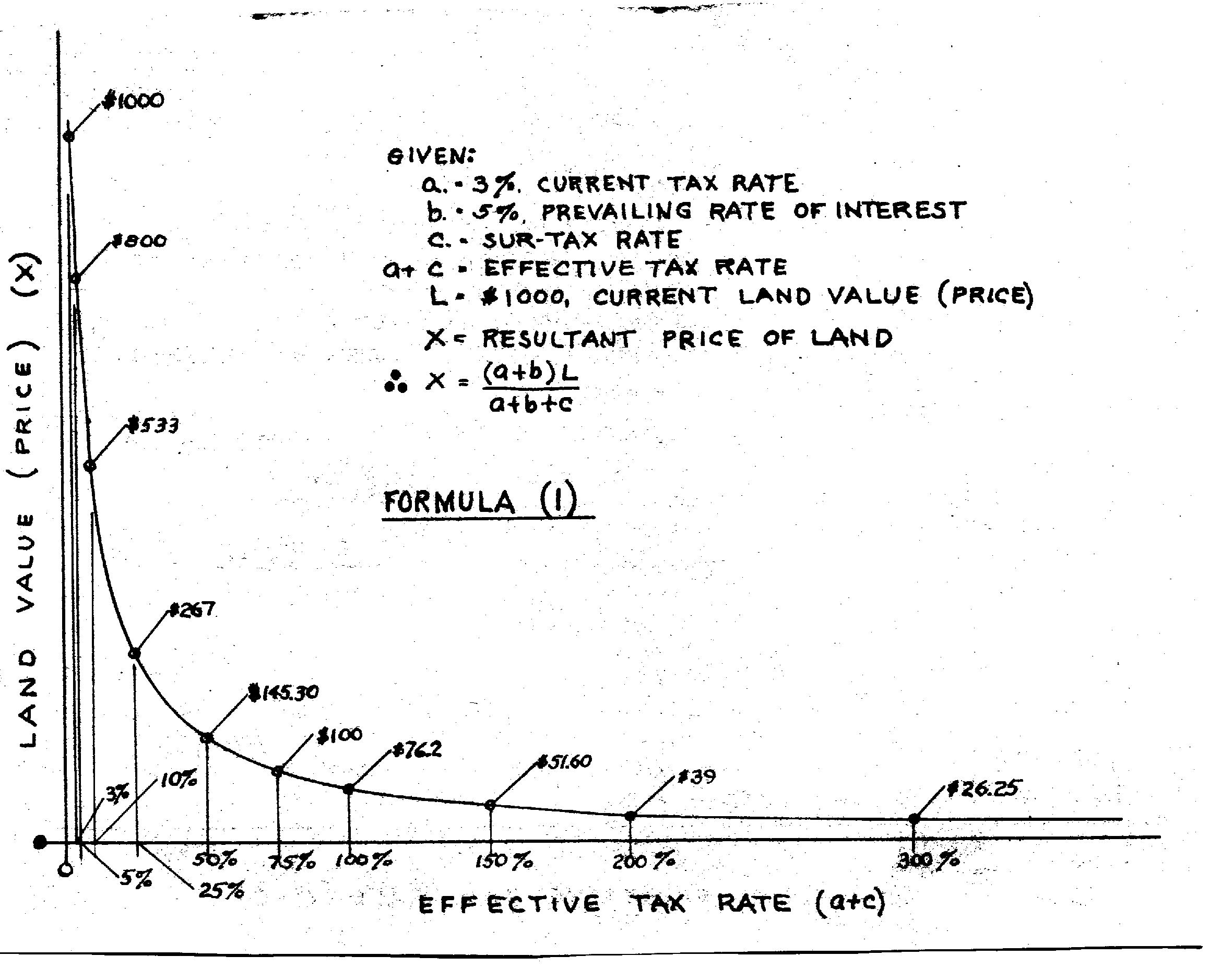
Using nominal values for a and b, as 3% and 5% respectively, and
solving for X in Formula 1, for various rates of taxation (a + c), we
may construct a graph to show the ratio of X to tax rates. There will
be a rapid decrease in X for small initial increases in tax fates,
following nearly a straight line until at a 20% effective tax rate,
where the value of X would be at about 30% of the initial Land Value.
Then the line would curve sharply to where at a 50% tax rate, X would
be at about 15% of the initial Land Value. At a 100% tax rate, X would
be at about 7%% of initial Land Value. At a 200% tax rate, X would be
at about 4%, and so on until at a tax rate of infinity, which is
impracticable, X would be at zero.
CHART II
For further study of this phenomenon, we may set up another algebraic
equation for tax revenue, (T):
Let T = (a + c)X
Formula 1a
From this we may construct a graph to show the amount of tax revenue
for the various rates of taxation (a + c), using X as derived from
Formula 1. Tax revenue (T) will approach the full economic rent at an
infinite tax rate. For the same nominal values used above for a and b,
tax revenue (T) will increase rapidly for small initial increases in
tax rates, following nearly a straight line until at a 20% effective
tax rate, T would be at about 80% of the rent. The line would
then curve sharply to where at a 50% tax rate, T would be at about 90%
of rent. At 100% tax rate, T would be at about 95% of rent. At 200%
tax rate, T would be at about 97-1/2% and so on to infinity at which
the maximum of 100% of rent would be taken.
Practical consideration in application of Formulae 1 and la would
lead to the conclusion that a gradual approach should be taken with
initially small increments of increase in tax rates over a
comparatively long period of time. Sufficient notice should be given
of all proposed tax rates to allow for market adjustments and to avoid
undue "jar or shock" to the economy. In fact it would be
practically impossible to get popular support for any drastic approach
to the ultimate application of the remedy.
TAX REVENUE RELATIVE RENT

As an appeal for acceptance of Land Value Taxation, it may well be
offered as an alternative for introduction of new taxes or increases
in taxation of other sources of public revenue, such as incomes,
sales, etc. It can readily be demonstrated that for a given increase
in public revenue, an increase in tax rate on Land Values would be far
less of a burden on the rank and file of commerce, industry, and labor
than the imposition of other forms of taxation. Furthermore, another
practical consideration of the application of Land Value Taxation
would be the limitation of the ultimate tax rate to about 100%. From
Formula 1, this would be at about 7-1/2% of the initial Land Value and
would be an incentive to greater investment of capital in commerce and
industry upon the land.
In words of Henry George, immediately preceding his proposal to
appropriate rent by taxation, "By leaving to land owners a
percentage of rent which would probably be much less than the cost and
loss involved in attempting to rent lands through State agency, we
may, without jar or shock, assert the common right to land by taking
rent for public uses." Since the levy of 100% tax rate would
provide about 95% of rent for public use, there would be left about 5%
of rent to private appropriation as compensation for administration. A
pragmatic approach to the ultimate tax rate should be made gradually
to determine the lowest percentage of rent to be left to induce proper
administration of land ownership while providing the maximum
appropriation of rent for public benefit.
Further consideration should be given to the statement by Henry
George: "We may put the proposition into practical form by
proposing to abolish all taxation save that on land values." This
would presume upon the ultimate removal of all taxes on such sources
as incomes, sales, etc., as well as upon buildings and other
improvements in or upon the land. Advocates of Land Value Taxation
usually present a program for comparable reduction or complete
elimination of taxes on improvements along with increase in tax rates
on land values.
An analysis of the Law of Rent as applicable to investments in real
estate should be made. The term "real estate" includes land,
which is a factor of monopoly, and improvements, which is a factor of
competition. A tax on land tends to decrease the market price while a
tax on improvements tends to increase the market price. The tax on
land can not be shifted by the land owner. The tax on improvements
must be borne by the tenant, who may or may not be the land owner. The
tax on improvements may be reflected in reduction of maintenance and
in curtailment of construction, which would continue until the market
is sufficient to reverse the trend.
In Formulae 1 and la we considered tax rates on land only. For a
differential in rates on land and improvements, by decreasing the tax
rate, or granting a rate of exemption on improvements, the yield for
investments in real estate tends to become correspondingly greater.
Thus there would be a compensating factor in a simultaneous increase
in the tax rate on land value with a rate of exemption on
improvements. The net result would depend upon the ratio of tax
exemption to tax increase and the ratio of values of the respective
bases upon which the rates would apply. If within a given area in
which the rates are to be adjusted, the total of land values is equal
to the total of improvement values, and the two rates were the same in
amount, there would be no reduction in land values nor any increase in
tax revenue. This would hold up to the point where the rate of
exemption is equal to the initial tax rate. Further decrease in the
tax rate on improvements would be negative and in effect a subsidy to
the land owner. Such is not to be considered in this analysis. For
complete exemption of improvements from taxation, with land values
equal to improvement values, and with a tax rate on land greater than
double the initial tax rate, land values would decrease and tax
revenue would increase.
If the ratio of total land values to total improvement values is
other than unity but equal to the ratio of rate of exemption to tax on
land values, there would be no decrease in land values nor any
increase in tax revenue. If, however, the ratio of land values to
improvement values is greater than the rate of exemption to tax on
land, there would be a decrease in land values and an increase in tax
revenue; conversely, land values would increase and tax revenue
decrease.
CHART III
To demonstrate the above statements, we may set up an algebraic
equation based upon the fundamentals of real estate investments - land
and improvements. The market price of land is the capitalization of
that part of the yield which is assured to the owner out of the rent
on land and sufficient to attract investment in the whole property.
On this premise,
- Let Y = yield, annual return on investment
- Let a - current rate of taxation, %
- Let b = prevailing rate of interest, %
- Let L = Land Value (price)
- Let I = Improvement Value
- then Y = (a + b)L + (a + b)I
- Let c = increase in rate of taxation, %
- Let d = decrease in rate of taxation, %
- Let x = resultant Land Value (price)
- then Y = (a + b + c)X + (a + b)I
- from which X = (a + b)L+dI / a + b + c
Formula 2
It may be noted here that if there is no exemption of improvements;
or d equals zero, Formula 2 is identical with Formula 1. With the
introduction of factor d, it is necessary to consider the relation of
all the factors; c, d, L and I. Using one factor only, d or I, as the
variable for each series of computations and solving for X, we may
construct graphs to show the relation of X to various tax rates and
property values. There should be several graphs, but all will follow
the pattern of graphs constructed from Formula 1.
It will be shown that when L/I = d/c, Land Values will be stabilized.
If L/I is less than d/c, Land Values will be increased; conversely, if
L/I is greater than d/c, Land Values will be decreased.
LAND VALUE (PRICE) RELATIVE TAX RATES AND EXEMPTIONS
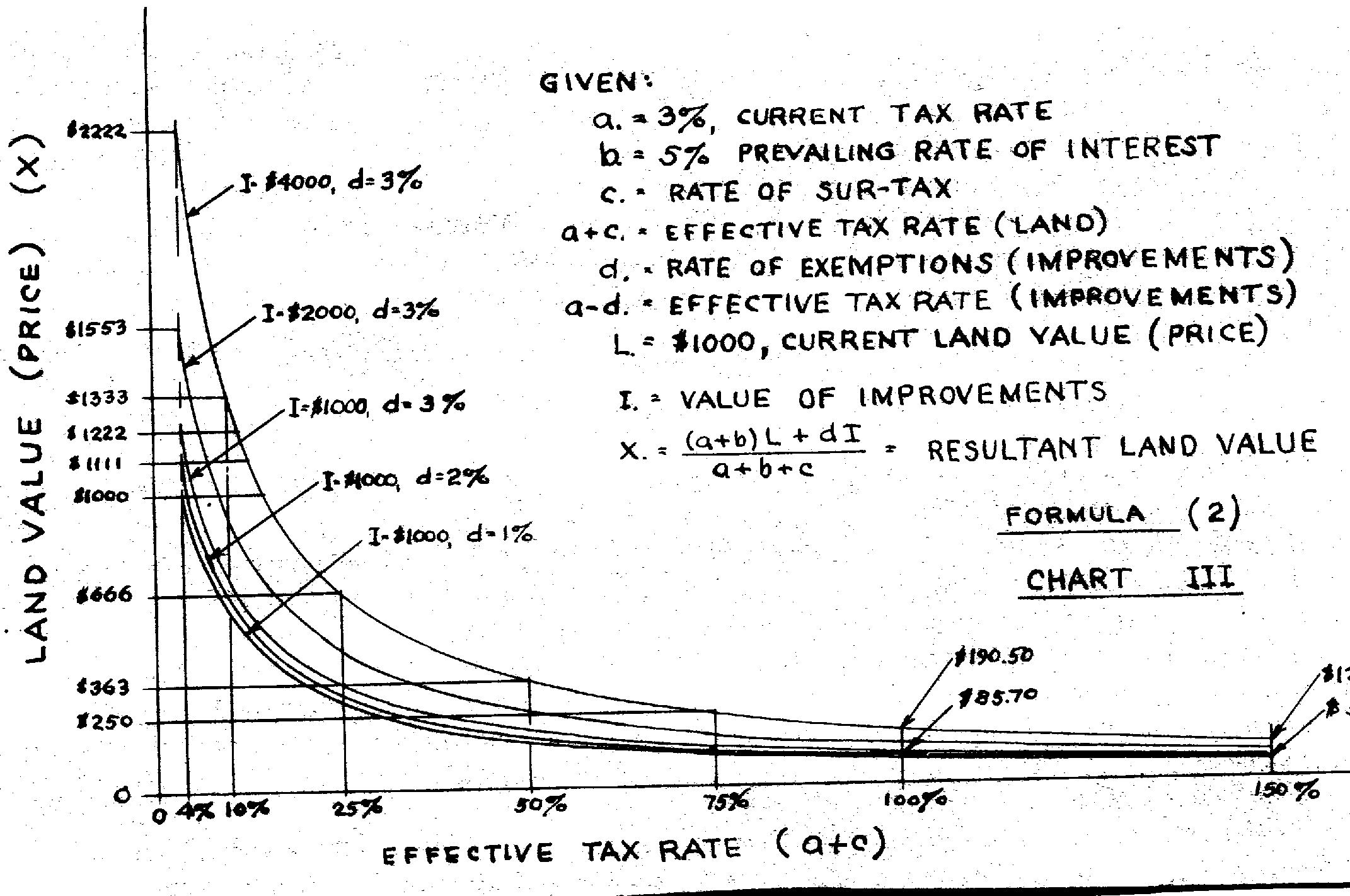
CHART IV
Having determined the resultant land value, X, for various rates of
taxation and relation of values, we may determine the resultant tax
revenue for the various rates and values. For this we set up another
algebraic equation for tax revenue, T:
T = (a + c) X + (a - d) I
Formula 2a
from which to construct graphs to show the relation of tax revenue,
T, to various rates of taxation and values. Using X as derived from
Formula 2, it will be shown that the several graphs follow the same
pattern as in those derived from Formula la. As Land Values, X,
decrease, tax revenue, T, increases and vice versa.
TAX REVENUE RELATIVE YIELD
For Land And Improvements

CONCLUSION
Taxation of land values, derived from the capitalization of that part
of rent assured to the land owners is the most efficient, practical
and safe mode of taking rent for public benefit. It avoids the danger
of any levy upon land holdings in excess of rent, and respects the
rights of private property. It takes as much of the rent for public
benefit as practicable and in the shortest possible time with popular
consent.
Land Value Taxation with the elimination of other modes of taxation
and provision against subsidies or privilege to land owners would, in
the words of Henry George, "...raise wages, increase the earnings
of capital, extirpate pauperism, abolish poverty, give remunerative
employment to whoever wishes it, afford free scope to human powers,
lessen crime, elevate morals, and taste, and intelligence, purify
government and carry civilization to yet nobler heights."
APPENDIX
By definition, rent may include charges upon land other than taxes
and interest. It may be designated as (G) for "ground rent"
or its equivalent, from which we may set up an equation for Rent:
- R = (a + b) L + G
- then Formula 1 becomes:
X = (a + b) L + G / a + b + c
- and Formula 2 becomes:
X = (a + b)L + dI + G / a + b + c
In the use of these formulae it should be noted that the factors a,
b, c and d are percentage points while G is an amount so that the
percentages do not cancel out unless G is multiplied by 100. For
simplicity or brevity in this analysis, the use of "ground rent"
or equivalent charges, is neglected but the patterns of graphs for X
and T will be the same as when derived from formulae 1, la, 2 and 2a.
Land Speculation - Boom and Bust
In substance as presented at the Henry George School Conference
in St. Louis, Missouri, 23 July, 1966
For many years the world of business, finance and industry has been
stimulated, from time to time, with increased wages, prices and
profits,, associated with land prices, only to be depressed by an
economic decline. This phenonenon is well illustrated on a "Chart
Showing Land Price Swings in Chicago, 1830 to 1956", which is
contained in an article on "LAND" in the August 1960 issue
of "House and Home". On this chart, land prices are shown as
rising at relatively fixed nominal rates of increase over relatively
long periods of time followed by rapidly rising land prices and,
subsequently, by rapidly falling land prices, over relatively short
periods of time.
These cycles do not cover fixed intervals of time but do show that
rapid rises in land prices are always followed by rapid declines with
inevitable depressions. This is the picture of "Boom and Bust".
An analysis of the influence of speculation on land prices should show
the cause of spectacular rises in prices and lead to the remedy for
effective control.
Speculation in land tends to set up chain reactions without any check
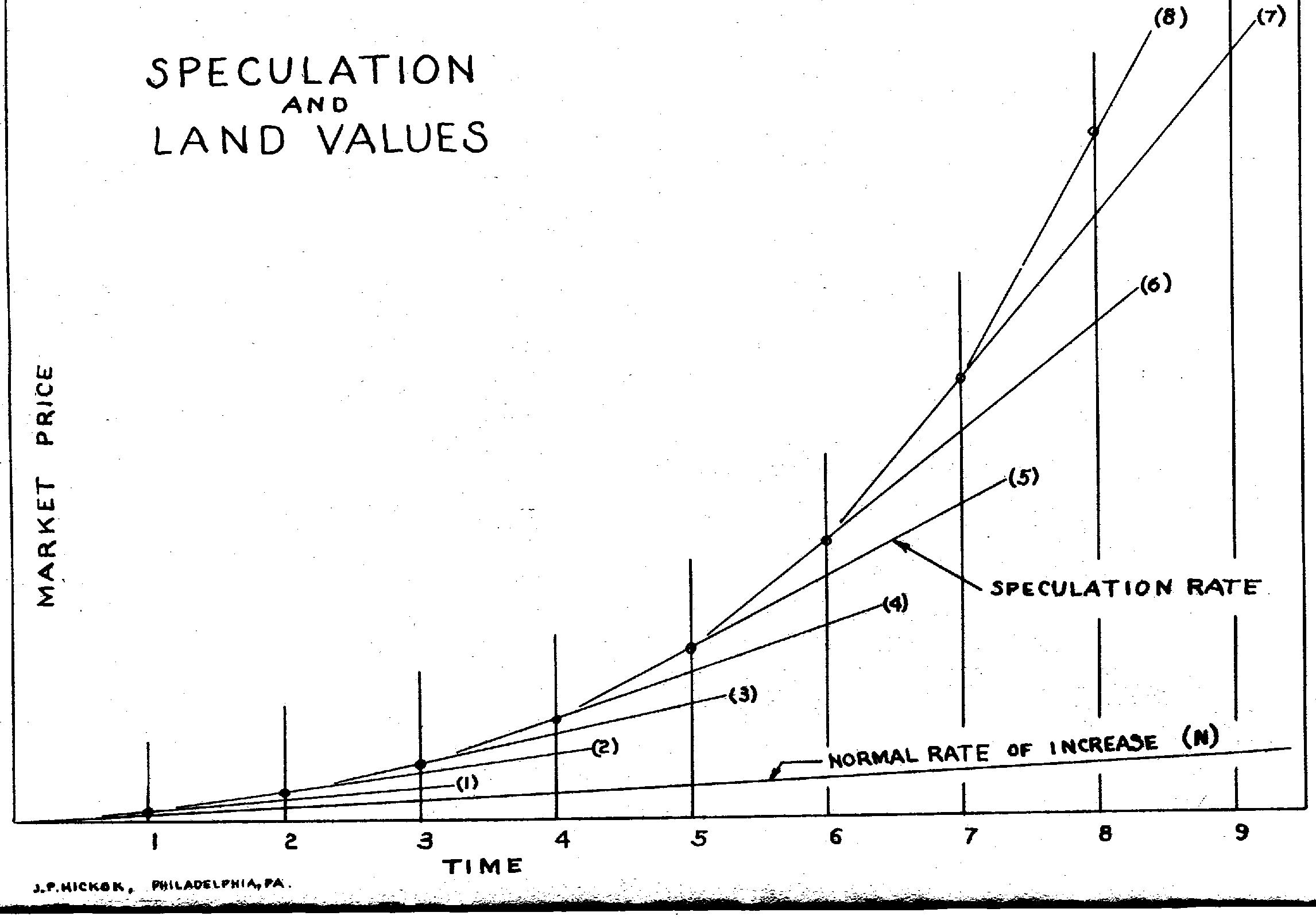
on prices. The effect of speculation is illustrated on the
accompanying chart. This comprises a graph, line N, of normal rate of
increase in land values, and graphs, lines (1), (2), (3), etc., of
rates of increases in land prices due to speculation.
Taking a position of time, as at (1), we may have a land owner
willing to sell but wanting to discount as much as possible on future
increases in value, or price. A prospective buyer is willing to pay
more than the actual value at the time, in anticipation of future
increases. The sale is consumated at some price above the true value
as shown by line (N). The difference is an increment of speculation.
Using such transactions as average for the period, there is an
apparent increase in the rate of increases in land values, as shown by
line (1).
Taking another position of time, as at (2), we have another
contingency of seller and buyer, the same as at (1). Thus the selling
price will be above the price designated by line (I), and the rate of
increase will appear to be as shown by line (2). At another position
of time, as at (3), the increment of speculation will then be greater
than that designated by line (2) and the rate of increase will appear
to be that as shown by line (3). With each position of time, as at
positions (4), (5), (6), etc, the apparent rates of increase in land
values will become increasingly greater as shown by lines (4), (5),
(6), etc, respectively, with increasingly greater increments of
speculation. This tends to bring the selling price of land far in
excess of true values, line (N), at the respective positions of time.
It is obvious that as the speculative price of land greatly exceeds
its use value, the buying of land is stimulated not for use but for
future profits. This tends to discourage the use of land and to
encourage the withholding of more and more of land out of use for
future profits, particularly under the realization of extremely high
taxes which would be levied upon any industry applied to it. As
opportunities for employment of labor and capital are thus reduced,
industrial paralysis is sure to follow. When the fever of speculation
has run its course, land held at speculative prices will be forced on
the market, precipitating a rapid decline in all prices, causing
bankruptcy to those caught at the peak and great loss to many who had
inadvertently supported them in the rise in land prices.
The resulting depression will then continue until the damage to the
economy from land speculation has been absorbed. With land prices
reduced to levels justified by increased technology and with
willingness of labor and capital to accept less remuneration, industry
will be normalized and another cycle of land price swings will again
be started. The question is, how many such shocks to our economy can
our civilization endure?
SPECULATION AND LAND VALUES
CONCLUSION
The simple but sure remedy for control of land speculation is
available. Our tax structure should be modified to insure that
increased revenue from land, as such, be taken for public use. We
already tax land values along with building and improvement values. We
have only to establish a policy of increased tax rates on all land
values, actually prices, to control sufficiently the incentive to
speculate in land.*
With the control of the increments of speculation in land, more land
would be readily available for use. Wages to labor and profits to
capital would be increased, repeated shocks to our economy would be
avoided and ultimate collapse of our civilization would be
forestalled.
*APPENDIX
In "Progress and Poverty", Book VIII, Chap. 2, Henry George
writes: "What I, therefore, propose, as the simple yet sovereign
remedy, … is to appropriate rent by taxation."
Whatever procedure must be followed to implement the proposal of
Henry George it must be in form, degree and extent compatible with
popular support. There are two prime factors involved. One is the
assessed valuation of the property and the other is the tax rate.
At the conference of the Henry George School of Social Science in
Montreal, Canada, July 1967, Ted Gwartney, Southfield City Assessor,
told the story of Creative Taxation. This was repeated at the
Conference in Miami Beach, Florida, July, 1968. The Southfield
(Michigan) Plan is to assess all land equitably, irrespective of
improvements, and then to levy upon it the overall real estate tax
rate. This presents a new phase in land value taxation.
Previously, consideration was limited to differential rates of
taxation on land and improvements. To some it is considered more
important, first to lower the rate on improvements and then to
increase the rate on land, to compensate for the loss of tax revenue.
The Pittsburgh Plan, which was designed to stimulate construction, is
an example of this. To others, it is more important, first to increase
the tax rate on all lands and then, out of the increased revenue, to
lower the rate on improvements, providing a net gain in the overall
revenue.
The Southfield Plan is a variation of these procedures. It is based
upon impartial assessment of all land, irrespective of improvements.
This is in effect an increased assessment of vacant or underdeveloped
land, nominally underassessed in many other cities now plagued with
land speculation.
The ultimate goal of land value taxation would involve a long range
program to be worked out, step by step. The Southfield Plan might well
be the first phase in such a program. With popular acceptance of it,
differential rates of taxation might be more readily adopted, pointing
to the ultimate goal of abolition of all taxes save those affecting
the taking of rent for public benefit.
|