The Triumph Of Christian Civilization
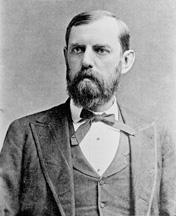
Richard Franklin Pettigrew
[An excerpt from the book, Triumphant Plutocracy,
The Story of American Public Life from 1870 to 1920. Pettigrew was
born in Vermont and moved with his parents to Wisconsin in 1854. He
studied law in Iowa, and entered the law department of the University
of Wisconsin-Madison in 1867. He moved to Dakota in 1869 to work with
a United States deputy surveyor. Pettigrew settled in Sioux Falls,
where he practiced law and engaged in surveying and real estate. He
was a member of the territorial House of Representatives and served on
the Territorial council. He was elected as a Republican to the U.S.
House, serving from March 4, 1881 - March 3, 1883. He was an
unsuccessful candidate for reelection in 1882, but returned to the
territorial council from 1885 to 1889. When South Dakota was admitted
as a state, Pettigrew was elected as South Dakota's first Senator to
the United States Senate. He served from November 2, 1889 to March 3,
1901]
Perhaps I can say more effectively what I tried to write in the last
chapter by means of an allegory which tells, in simple form, the story
of our blunders.
One hundred years ago a colony of English farm laborers, one hundred
in number, composed of men, women and children--old and
young--chartered a ship and started for Australia. They were inspired
to go by the promise of free land they and their ancestors having been
tenants upon an English estate.
The ship was a sailing ship and the colonists loaded it with their
second-hand furniture, second-hand bedding and second-hand farm
implements. They also obtained some seeds from a charitable person who
was willing to await the success of the colony for the return of his
investment ; and, with the seeds and agricultural implements, they
started from England for Australia by way of Cape Horn. The voyage
across the Atlantic was successfully made ; the cape was rounded and
the ship stretched her sails as she moved away into the broad Pacific.
The colonist, who knew little of sailing routes soon got off from the
ordinary track of vessels and, when well out in the Pacific Ocean, ran
their ship aground upon a sunken reef which stove a hole in the bottom
and placed it beyond repair.
Consternation prevailed among the passengers. Some fainted. Others
ran up and down the decks, nearly insane from fear. The cooler heads
soon restored order however, and all hands were organized to save what
they could out of the wreck. When it became evident that the ship was
in no immediate danger of sinking, the faint-hearted regained courage
and all went to work with a will.
There were two young men -- healthy and strong -- who seemed to take
no interest in the salvage plans, but busied themselves with trying to
release from its lashings the only life-boat upon the ship--a very
small boat, which was all that the colonists, out of their meagre
funds, could afford.
A study of the situation showed the leaders of the party that their
condition was by no means hopeless. The ship did not fill rapidly and
about ten miles south of the wreck, land could be made out. There was
no wind, the sea was calm. Their one boat was too small to be of any
great use, so the voyagers decided to build a raft out of the ship and
try to reach the land south of them. So they all started to work--with
the exception of the two young men--constructed their raft on the
leeward side of the ship and began loading it with their belongings.
Before they had gone far with the loading, they found that the raft
would not carry over one-half of the colony. So they took the old and
the helpless and the children, and half of the most ablebodied, and
proceeded to propel the raft to the land, while the others were
picking up and putting in shape the remainder of the cargo and the
stores.
The occupants of the raft landed upon the island without difficulty.
Apparently, so far as they could see, it was a complete and absolute
desert. They had noticed, before they left the ship, that the two
young men, who had been hanging around the life-boat had disappeared,
and that the life-boat, as well as all the arms and munitions on the
ship had disappeared with them. These men had rendered no assistance
whatever in rescuing their fellow-beings from the wreck, and they had
deserted the ship at the critical moment, with the only seaworthy
craft that the colonists possessed.
After the first raft cargo had been landed, a few of the men returned
with the raft to the ship, loaded their implements and the remainder
of the food and taking aboard the rest of the colony, returned to the
island. For the next day or two, the shipwrecked colonists gave their
attention to stripping the ship taking such parts as they could
detach, to the island, and constructing temporary shelter. After all
that could be moved was taken to the camping place they had selected,
three of the company were chosen to explore the island, while others
were detailed to manufacture a temporary boat in order to see if there
were eatable fish in the waters surrounding the island.
Those who had been sent to explore the island soon returned with the
report that they had found a body of very fertile land several miles
in the interior of the island, that this land was about three thousand
acres in extent ; that there was a large spring of water in the centre
of it, and that it appeared to be the only cultivatable land upon the
whole island. They reported further that the two young men, who had
abandoned their fellows were there in possession of the fertile land,
and that when the committee proposed to bring all the other people up
to the spring of fresh water and the fertile land, the two young men
replied that they, having discovered the oasis, were the lawful owners
and they proposed to stand upon their right to retain it. When the
committee insisted that the land should not be privately owned but
should be the common property of all--as man was a land animal and
fertile soil was absolutely essential to his existence--the two young
men who had in their possession all of the arms on the ship, first
argued that the committee must not undertake to discourage individual
initiative-- that it would be ruinous to civilization not to encourage
individual enterprise and that the land belonged to them by right of
discovery. But, when the committee pressed the point and urged the
rights of man, the two young men said : "We have all the arms and
ammunition that are on this island, and if you undertake to force
possession of this land, we shall fire upon you."
After hearing the report of their Committee, the colonists held a
meeting and decided that it would be a great mistake to discourage
individual enterprise or in any way throttle individual ambition. They
and their ancestors had always paid rent to a landlord ; they had been
taught to believe that it was the rights of property that were sacred
and not the rights of man, and so they resolved to move on to the
three thousand fertile acres and pay rent for the use of them. So they
gathered together the old and the helpless and the little children and
moved them first, and then they moved all of their belongings,
including their supply of food and seed and implements, without any
help whatever from the two young men who were busily guarding the
results of their enterprise.
The Colonists set to work at once to cultivate the land and put in a
crop. The two young men married the two most likely young women on the
island, and the two young women and their relatives esteemed it a
great catch.
After the first crop was harvested, the young men, by promising a
little reduction in rent, put the whole laboring population at work
building them a house that corresponded with the importance of their
position. The workers hewed, with their rough tools, the coral rock
out of the barren portions of the island and constructed a very
splendid residence for the ruling classes. After the house was
finished and the workers had manufactured as best they could, out of
the wood obtained from the ship, furniture with which to stock it,
they began to construct hovels of stone and earth for themselves and
their children, and their aged and their sick.
So matters went on for several years, during which about two thousand
acres of the fertile land were brought under cultivation. Meanwhile,
the population had increased and their labor had made a beautiful park
out of the remaining thousand acres which surrounded the residence of
their lords. They had also built a heavy wall around the thousand
acres so as to protect the park from encroachment.
The leaders of the colony still dreamed of resuming their journey to
Australia, and in the little spare time they had between planting,
harvesting and building, they explored the island. On the end farthest
removed from the oasis, they found a deep and rugged ravine,
containing some scrubby vegetation, and coming down from a
considerable elevation that suggested volcanic origin. In the ravine
they discovered gold in great quantities and immediately began to
extract it from the soil. It was placer gold and came out in big and
small nuggets.
After gold was discovered, the oldest of the two colonists, who had
appropriated all of the fertile land upon the island, took the title
of Lord Goldfield, and the whole population turned out for a holiday
to celebrate the event. They attended services in their churches and
were told by their spiritual advisers that it was a great providence
of God's which had bestowed upon them so kind and beneficent a ruler
as the lord of the province ; that, in fact, their lord had received
his title direct from God ; that it was of divine origin and was sent
especially to them by the great Ruler of the universe because of his
loving care.
In addition to the gold, some of the colonists discovered at the
headwaters of the stream upon the banks of which the gold was found, a
small band of wild goats. The goats were very thin and their hair was
not of the finest quality ; but immediately upon the discovery of the
goats the lords of the palace had them removed to the one thousand
acres which they had walled in as a park around their mansion, and
great care was exercised in their breeding so that only the best
qualities were reproduced. These efforts met with great success. The
inferior goats were sterilized and only those allowed to reproduce who
were of the very best quality. The animals became strong and large and
covered with a wooly coat, and were thus suitable for beasts of
burden, and to furnish wool for cloth, and milk for the children of
the rich.
As a result of this achievement, the other young man took a title --
the title of Lord Angora, in honor of the discovery of the goats. And
again ceremonies were held and a holiday proclaimed and the population
instructed in the divine origin of this title.
But while birth control was exercised with regard to the goats, and
great care taken to see that they were properly fed, the common people
of the colony were taught that it was wicked to interfere with the
processes of nature, and as the population had brought with them the
usual diseases common to the sexes in Great Britain, there were
increasing numbers constantly among the inhabitants of those who were
diseased and of those who were mentally defective ; in fact, a very
large number of dependents had grown up and the slums had appeared,
and as they took no care with regard to sanitary affairs, epidemic
diseases--the result of the poisoning of the population by their own
filth--spread among them and reduced the population from time to time.
And the people were taught that this was a visitation by Providence to
punish them for their failure to appreciate the glory and goodness of
God ; that they should read the Bible every day and observe Sunday and
attend Church and above all, contribute to the support of the Church
and God's representative- -the preacher, who had ordered a day of
fasting and prayer to appease the anger of the Deity. And the preacher
chanted--"God is great and God is good ; He provideth our daily
food ; by His hand we are all fed ; give us now our daily bread."
And the people cried "Halleluliah, Glory to God." But God's
wrath was so great that He would not hear, and the epidemic ran its
full course. The preacher then told the people that the only way to
prevent future epidemics was to be more devout and that God, above all
things, loved a cheerful giver.
The rulers of the island had planned and directed the construction of
large warehouses which were used to store the products of the land.
Many colonists were improvident. They would sell off what they
produced and use up the returns so that they would not have enough to
last them until the next crop. As the population grew and life became
less bearable the number of the improvident increased. The two
thousand acres under cultivation yielded three crops a year ; was
intensely cultivated and produced an abundance of supplies. The ruling
classes, who owned the gold mines as well as the fertile land, knowing
that the value of money depended upon its quantity, decided that the
nuggets of gold should have a value in proportion to their weight or
size, and, of course, they decreed that the unit should be pounds,
shillings and pence. They also manipulated the money so that, when the
crop was harvested, the money was very scarce and therefore, the
prices were very low. They would buy the products of the land and
store them in their warehouses and, when the next crop was fairly in
the ground and improvident members of the community were entirely out
of food, they would make the volume of money exceedingly abundant,
prices would rise and they could thus charge several times what they
paid for the products of the laborer of the land. They soon found that
this was unnecessary for, as they were the only owners of money and
had the only warehouses that there were, they could arbitrarily fix
the price and thus exploit the population to the full extent of their
desire, through their trust control.
But a new problem had arisen. Malthus's theory that population would
outrun subsistence had come true. The two thousand acres would no
longer produce food enough to supply the population and the serfs
began to wonder how they would overcome the difficulty. They never
thought of encroaching upon the park because that was private property
belonging to God and the descendants of the two young men who had, by
their private enterprise, discovered and taken possession of it ; and
the descendants of these young men never, for a moment, thought of
plowing up the park, and they insisted that the miserable population
would have enough if they would exercise frugality and industry and
would educate themselves ; but they were ignorant and many of them
were idle and of but little consequence.
So a committee was appointed to explore the neighboring seas with the
hope of finding land. The expedition discovered some small islands,
almost entirely barren. On one of them, however, they found a human
being, clothed in palm leaves, who fled upon their approach ; but they
called to him and to their astonishment and joy he responded in the
English tongue. He had been upon the island for ten years, the only
survivor of a shipwreck and had subsisted upon roots, scant
vegetation, and the products of the sea, clothing himself with palm
leaves.
Of course he went home with the colonists and after he had fully
recovered, began to preach the doctrine of Socialism. He said the
rights of man were sacred and not the rights of property. He said that
every man should have all that his labor produces--that man was a land
animal and that the land was essential to his very existence, and that
no person should own more land than he could use and that, for the
idle to demand rent for the use of the land--the common inheritance of
all--was immoral and dishonest, and that they should immediately take
possession of the thousand acres in the park and put those acres into
crops. And many of the people endorsed his views.
But the ruling classes were not idle. They had watched his movements
; they sent their paid retainers, their lawyers, among the people and
argued that to take the park and not pay for it would be confiscation
and robbery ; that the present owner had inherited it from ancestors
who had acquired it by thrift and industry and enterprise. That if the
public appropriated it to the good of all it would destroy all
incentive to individual enterprise and stop the wheels of progress and
discourage ambition and return the world to barbarism ; and they also
wanted to know if they proposed to rob widows and orphans.
The ruler had also organized a standing army of trained men under the
plea that the colony might be invaded by savages from some unknown
island in the sea, and that an army was needed for protection. The
army was officered by men who had been brought up from childhood as
trained soldiers and taught that they must obey their superior
officers even unto shooting their own brothers and sisters, if
commanded to do so by the officer over them. And, as the commander-in-
chief of their standing army was by law the oldest son of the oldest
of the two men who had discovered the fertile land, the army was
ordered out, and they captured the socialist in the interest of law
and order, and stood him up against the wall which surrounded the one
thousand acres, and fired a volley into him and threw his body into
the moat.
Civil war at once commenced ; the population divided almost equally
on the great question of the sacred rights of property, and they began
killing each other until half of the people were disposed of. But as
the trained men with their guns were on the side of the owner of the
property, the people that remained alive stopped the unequal contest,
and right and might prevailed ; law and order triumphed ; the
congestion was relieved ; the park was saved ; the people agreed to
continue to pay rent, and Christian civilization pursued its peaceful
and solemn course.
|